Divorce & Lassie
Divorce is a difficult and troubling time for most. Divorce gets especially hard when a couple has to determine what to do with Fido, Zeus or Sebastian.  The pet industry is a multi-billion dollar industry. For many Americans without children, or for even those with children, the family pet is just that – FAMILY. Thus, what happens to your furry loved one in a divorce can have serious emotional impact for all involved.
The sometimes callous and impassionate legal system regards animals as chattels. A chattel is a tangible, movable, or immovable, item of property, except real estate or other things connected with reap property. In other words, a pet is a piece of property. That’s a pretty cold definition of a member of our family! NRS 193.021 states, “personal property includes dogs, domestic animals, and birds.”  Unfortunately, or fortunately, depending upon your point of view, in the eyes of the law, your pet is akin to a vase or a car. Under NRS 41.740, “a person can sue for damages should anything happen to his or her animal, not to exceed $5,000.”
According to NRS 123.130 and case law, all property acquired after marriage is presumed community property, which is to be divided equally.   This creates an interesting dilemma when it comes to deciding what to do with the family pet upon divorce.  Only the judge’s discretion determines the outcome unless the parties can come to a mutually agreed upon agreement.  In an ideal world, a divorcing couple should put aside their differences and do what is in the best interest of the pet.
Should a new law be promulgated to elevate Lassie’s status above a piece of property? Should we establish a ‘best interest of the pet’ standard?  Do we order pet support?  These questions may seem comical but in reality, thousands of dollars are spent by divorcees willing to pay large sums of money to care for Lassie.
 While this is still a growing and fluid area of the law, the Court has options that it can consider when handling this issue.  Factors such as, who purchased Lassie, who is the registered owner, bring Lassie into the courtroom and see who Lassie runs too or whoever gets the house, gets Lassie.  While these may not seem ideal ways to decide who gets Lassie, it’s all we have until the law catches up understanding our love for Lassie and Fido.
“GOD couldn’t be physically with us so he gave us dogs…& notice Dog spelled backward is GOD and they both show unconditional Love!”~author unknown
By Tanika Capers, Esq.
Poor and Educated Part II (The Value of A College Education)
In last month’s Money Matters column, I talked about the severity of the student loan debt crisis in America.  To highlight, Americans, owe more than $1.3 trillion in student loans debts and the only debt category higher is mortgage debt.  We are essentially mortgaging away our future by paying for our past!  Part of the reason we struggle to build wealth is because we have gone into such deep debt in the pursuit of an education.  Don’t get me wrong; I have a high regard for education and I believe if you can get an education and it will help you in the future, you should get it!  But do it wisely! Let’s talk about some things we can do to make sure the money we are spending on making ourselves better is well spent!
First, let’s talk about your choice of school.  Do you want to go to any Ivy League college?  According to ivycoach.com, Princeton is the cheapest Ivy Leagues University and tuition and fees cost just over $61,000 in the 2016-2017 academic year!  Yeah, that’s a little pricey for me.  So if you are like me, and you don’t have Ivy League money a state school would be a great alternative!  Even better, you could attend a state college (which is usually cheaper than private schools) in your home state and save on out-of-state-tuition!  Community college may also be an option and they are even cheaper than state colleges.  Although community colleges may not offer the degree one is seeking, It is not uncommon for a student to start at a community college and after a year or two of taking all of their prerequisites, transfer to a nearby state college.  There are several ways to get an education you just have to realistically look at your options and devise a plan.
If you are going to earn a degree or pursue a certification, you have to know how much your degree/certification is going to cost you (in time and dollars) and you should know how it will benefit you when you graduate.  Do not choose to be clueless!  The cost to get an education can be found on the school’s website and you can get an idea of what kind of money to expect from sites like salary.com  And if you are not willing to settle for the income commensurate with your career choice, then you might want to reassess.  You also need to know the marketability of your prospective degree.  For example, teachers, doctors, lawyers, engineers, and mechanics are usually in demand and these professionals can find jobs just about anywhere.  But if your degree is in Egyptology, Bag piping, Canadian Studies, Comic Art, or Auctioning, your career opportunities are much more narrow.  I know in this American culture, it is popular to encourage people to “follow their heart” no matter what the cost, but that is just unwise.  I’m not telling you to chase the money and work a job you hate because it pays well, but I am saying you have, and will likely gain more, responsibilities that must be considered.  It may be possible to satisfy your heart’s desire through another means other than your occupation like through volunteer services, a second job, or a society club.  It’s just something else to think about.
Like I said earlier, I have a high regard for education.  People should never stop learning and getting a formal education is a great way to learn.  But, just like most things in life, there are multiple ways to go about it. Investing in an education can be a big step and it is worth the extra time it takes to count the cost (Luke 14:28-31). Doing some research and planning
will bring focus to your goals, making you more efficient and can easily save you tens of thousands of dollars!  This gift of life God gives is short (James 4:14) and too precious to waste.  And we only have a limited amount of resources (ability, time, and money).  So, if you, or anybody you know, is pondering the thought of getting an education or some training, I recommend taking the time to do some detailed planning.  Besides, like Benjamin Franklin said, “By failing to plan, you are planning to fail.”
By Alfred King, Financial Consultant
Building a Healthy Family
Building a healthy family relationship is essential for families of all types. Whether it is a married couple, a family of four or a single mother and her adopted child, families thrive on love. Without a healthy family relationship, it can feel like someone has no one to turn to in times of crisis and or times of celebration. Healthy family relationships do not come automatically–they come with time and effort. The concept of family goes back to the origins of creation. When God created Adam and Eve, he told them, “Be fruitful and multiply” (Genesis 1:28). As a result, the first family came into being, and even though it got off to a rough start, families have been the basic building block of humankind ever since.  In an effort to reverse the trend of destructive relationships and strengthen the infrastructure of our society, we must be committed to the education, promotion, and support of each other through prayer, communication, fellowship, resources and most importantly making God and His Word first in our homes. Families play a large part in giving us self-confidence, validation, and self-esteem. Our society considers families the basic unit of the social order: Strong families form the basis of strong communities.
If you are building or rebuilding your family, I pray that these five principles will be a guide for you and your spouse. I am standing in Faith with you, that God will give you and your children the breakthrough that you are praying for, these are simple but applicable steps that can bring positive results in the health of your home.
 
Family Principle 1, “Eat Dinner Together”
 
Find the time to eat dinner together as a family.  Eating together as a family is a healthy habit that helps to bring everyone together. I believe eating together teaches children proper etiquette and it is an opportunity for open communication.  It is a time to bond, be involved and build intimacy. Even if you don’t have children, eating together allows you to relax from the busy pace of work and just talk.  It is nothing like hearing the laughter and conversation of family around a dinner table. “How good and pleasant it is when God’s people live together in unity” (Psalm 133:1).
Family Principle 2, “Quality Time”
 
Spend quality recreational time together doing activities that each of your family members enjoy. Even if your children are adults, take the time to plan family time. You can play board games, attend a concert, go the movies, go see a play, go to a game or read a book together. Creating regular family rituals is vital in showing your family they are important. If you are blending your families invite the all children to be involved; making every attempt to be a peacemaker.  Spending regular time together is what makes a family a tight unit. There is a famous quote that states “Your family needs your PRESENCE more than your PRESENTS”.  “Therefore if you have any encouragement from being united with Christ, if any comfort from his love, if any common sharing in the Spirit, if any tenderness and compassion,  then make my joy complete by being like-minded, having the same love, being one in spirit and of one mind” (Philippians 2:1-2).
Family Principle 3, “Respect”
 
Respect each other’s personal space. If your spouse asks for some alone time, give it to them.  Children learn respect, how they see parents respecting one another. If your children at times need quiet time, teach them to build healthy boundaries. Everyone needs time alone, and respecting privacy is one of the things that build solid relationships. If you have multiple children, it is important to give each one of them, their time alone with you, as the parents. Take your son to a sporting event while your spouse takes your daughter to a movie or nail salon.  It is very important that we as parents pray for wisdom in raising our children. God gave each of them different personalities and they will have their own journey in life.  Respectfully, we have to give them their space to grow and develop. Alone time with parents helps children feel special, it is their personal time of validation and an opportunity to learn from their first classroom “Home”.  “Be devoted to one another in love. Honor one another above yourselves” (Romans 12:10). 
 
Family Principle 4, “Communication”
 
Allow everyone in the family to openly communicate feelings respectfully.  I believe that to maintain a healthy family relationship, each member must be able to communicate freely with one another, as well as listen effectively. Listening allows you to learn more about your family’s thoughts and personalities. Communicating allows you to express yourself to relieve frustrations and other emotions. When your family is having a discussion try never to interrupt a family member through disrespectful tones, demeaning words, or through passive aggressiveness; instead, listen until he/she is finished, then relate how you feel. This effective type of communication prevents and solves arguments, keeping the family relationship healthy.  “A gentle answer turns away wrath, but a harsh word stirs up anger. The tongue of the wise adorns knowledge, but the mouth of the fool gushes folly”  (Proverbs 15:1-2).
Family Principle 5, “Financial Security”
Many families struggle when comes to financial freedom. Trying to juggle life, responsibilities, priorities, and extra curricular activities can be overwhelming. The key to good money management is expense management. We need to learn to live below our means and be content with what God has given us. This is hard for all of us, but it is a valuable life lesson. Developing a good budget is key. Everything we have comes from God. He owns it, and He entrusts it to us to use for His purposes. True financial success comes not from accumulating a large surplus in our bank account, but from following God’s plan for our finances. As we do this, He will provide for all of our needs. As Christians, our first financial priority, just as in every other area of life, should be God and His work. “And my God will meet all your needs according to the riches of his glory in Christ Jesus” (Philippians 4:19 NIV).
Pastor Clinton House
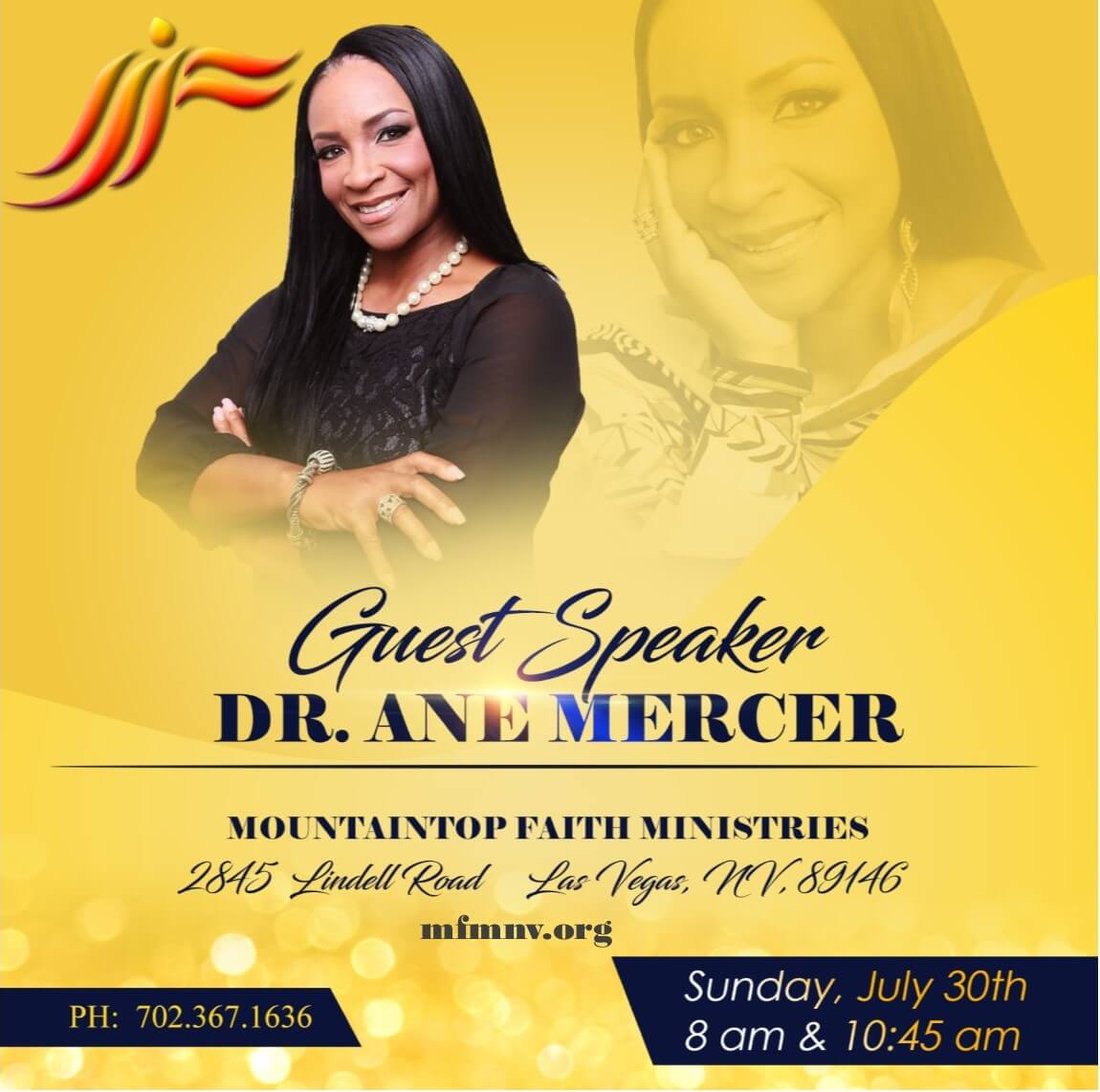
Summer of Worship and Praise Dr. Ane Mercer

Summer of Worship and Praise Pastor Tonya Hall

Just talk to Him
Prayer is as simple as talking to God. It’s like having a conversation with your very best friend!  He desires to hear from you in every way.  He desires to hear from you on your best day.  When your world seems like its falling apart; he wants to hear from you.  No matter the time or circumstance, He’s available and wants to share with you.  Start inviting Him into your day.  There is nothing better than talking to the Creator of ALL things in the midst of your day.  Allow God to brighten your day and restore your smile with His sweet whispers. There is no better friend than Christ and He is waiting to hear from you!
#talktoHim
“Don’t Let The Heat Exhaust You”
For approximately eight days in June, the temperature in Las Vegas sweltered in the 110-117 degree range.  The weather station issued “heat advisory warnings,” asking  people to stay indoors. Being outdoors in the heat can lead to the body overheating, causing heat exhaustion.
Heat Exhaustion is a condition whose symptoms may include heavy sweating and a rapid pulse, a result of your body overheating. It’s one of three heat-related syndromes, with heat cramps being the mildest and heatstroke being the most severe.
Causes of heat exhaustion include exposure to high temperatures, particularly when combined with high humidity, and strenuous physical activity. Heat exhaustion symptoms may develop suddenly or over time, especially with prolonged periods of exercise.
Symptoms of heat exhaustion begin to appear when your body becomes unable to regulate its heat loss. Hot weather, strenuous activity, alcohol consumption, and overdressing can all promote overheating.
According to Mayo Clinic, symptoms of heat exhaustion can appear suddenly or over a period of time. Faintness, nausea, dizziness, and fatigue are common symptoms, as are headaches, low blood pressure upon standing and heavy sweating. If your skin is cool, moist and has goosebumps even though you are in the heat, you may be experiencing heat exhaustion.
Pay attention to your symptoms of heat exhaustion and stop your activity to rest, find a cooler location, and rehydrate. If the symptoms worsen, contact your doctor. If your body temperature is 104 F or higher, seek immediate medical attention.
 
Information provided by Mayo Clinic
“THE CREDIT CARD ACT OF 2009-PART II’ 12 CONSUMER PROTECTIONS YOU NEED TO KNOW
Last month, we learned about the ‘Credit Card Accountability Responsibility and Disclosure Act of 2009’ promulgated by former President Barack Obama.   Let’s get to the nuts and bolts of what you need to know.
  
CARD Act highlights:
1. Limited interest rate hikes: Interest rate hikes on existing balances are allowed only under limited conditions, such as when a promotional rate ends, there is a variable rate or if the cardholder makes a late payment. Interest rates on new transactions can increase only after the first year. Significant changes in terms on accounts cannot occur without 45 days’ advance notice of the change.
2. The right to opt out: Consumers have the right to opt-out of — or reject — certain significant changes in terms on their accounts. Opting out means cardholders agree to close their accounts and pay off the balance under the old terms. They have at least five years to pay the balance.
3. Limited credit to young adults Credit card issuers are banned from issuing credit cards to anyone under 21 unless they have adult co-signers on the accounts or can show proof they have enough income to repay the card debt. Credit card companies must stay at least 1,000 feet from college campuses if they are offering free pizza or other gifts to entice students to apply for credit cards.
4. Clearer due dates, times: Issuers have to give card account holders “a reasonable amount of time” to pay on monthly bills. That means payments are due at least 21 days after they are mailed or delivered. Credit card issuers are no longer able to set early morning or other arbitrary deadlines for payments. Cutoff times set before 5 p.m. on the payment due dates are illegal. Payments due at those times or on weekends, holidays or when the card issuer is closed for business are not subject to late fees. Due dates must be the same each month.
5. Limits on over-limit fees: Consumers must “opt-in” to over-limit fees. Those who opt out will have their transactions rejected if they exceed their credit limits, thus avoiding over-limit fees. Fees cannot exceed the amount of overspending. For example, going $20 over the limit cannot have a fee of more than $20.
6. Minimum payments disclosure: Credit card issuers must disclose to cardholders the consequences of making only minimum payments each month, namely how long it would take to pay off the entire balance if users only made the minimum monthly payment. Issuers must also provide information on how much users must pay each month if they want to pay off their balances in 36 months, including the amount of interest.
7. Late fee restrictions: Late fees are capped at $25 for occasional late payments; however, the fees can be higher if cardholders are late more than once in a six-month period.
8. Gift cards expiration rules: Gift cards cannot expire sooner than five years after they are issued. Dormancy fees can only be charged if the card is unused for 12 months or more. Issuers can charge only one fee per month, but there is no limit on the amount of the fee.
“The most vulnerable consumers, those who carry a balance, have been protected by the protections of the CARD Act,” says Chi Chi Wu, staff attorney for the National Consumer Law Center, a Boston-based consumer advocacy group. “Some of the worst abuses were addressed, including retroactive rate increases. It put the brakes on some of the fees. They are still kind of high, but it kept them from going up.”
Poorly Educated Part I (The Value of A College Education)
I don’t think anyone would argue that times have changed.  In generations that have passed, all you had to do is graduate from high school and you were going to get a job that could take you all the way to retirement while earning a pension and allowing you to retire respectably.  But as advancement has taught us, the proverbial bar has been raised.  In this day and age, pension plans are few and far between and even having a college degree doesn’t guarantee anything!  If you want to make your mark in a given field, you almost need an advanced degree.  Having these advanced degrees definitely open up opportunities that would be closed without the extra knowledge and training, but it comes at a price.


This proves there is a certain value to education we cannot ignore.  It pays to be educated!  And just like everything that has value, getting an education cost!  And it cost more than it ever did before.  As tuition, books, room, board, and fees continue to rise, I can only see it getting more and more expensive in the future.  But what value do we place on education?
The cost of an education depends on few things.  Some of which are the schools where the degree is being earned (as some schools are just more expensive than others), the degree, itself, and the job market related to the degree.   But before we deal with those topics, which we discuss in subsequent articles, I want to take the time to contemplate the most prevalent method of paying for an education (the use of student loans) and how it affects the wealth of graduates.  See the following:
  • Americans owe over $1.3 trillion dollars in student loan debt.  Student loan debt is the second highest consumer debt behind only mortgages. (Forbes, 2017)
  • The average Class of 2016 graduate has $37,172 in student loan debt and 59% of millennial graduates say they have no idea when their student loans will be paid off. (US News, 2016)
  • The average monthly student loan payment (for borrowers aged 20 to 30 years old) is $351. (Student Loan Hero, 2017)
The income of graduates is being used to pay off debt rather than build their future.  Our graduates are gaining an education,  at a much greater cost than anticipated because it is mortgaged against their future earnings (i.e. their wealth building tools).  “How so?”, you might ask.  Let’s assume an average 23-year-old graduate is paying $351/ month for student loans for 10 years, which is the average to repay their debt.  If there was no debt, instead, that money every month is being put into a mutual fund investment.  Now let’s say after 10 years when the graduate is 33, they decide NOT to add anything else to the investment and is content with it doing nothing but gaining interest over the years.  When the graduate reaches the age of 65, with just average returns, they will have over $750,000 in that account!  Again, that is assuming they did not put a dime into the account from age 33 to 65!  If the graduate never stopped adding to the account, they easily could be a millionaire!  But instead of building wealth and securing a financial future, that money is paid to money lenders and banking institutions and they are making billions on top of billions from servicing debt!


Education is important.  I believe in education and I encourage everyone to seek it.   But we have to be wise in our pursuits.  We can’t get so enamored with the thought of getting an education that we just do what everybody else is doing.  Isn’t that the definition of average?  Didn’t God create us to be better than average?  Of course He did!  Remember, you are wonderfully and fearfully made (Ps. 139:14).  It’s time we start taking the road less traveled so we can reach our full potential.  There are alternates to loans such as scholarships, grants, work studies, internships, apprenticeships, and the most overlooked alternative of all, work.  All of these options might not be applicable; but they should, at least, be vetted.  Remember, Jesus warns us to count the cost before we make a commitment (Luke 11:28-31).  Now we see how expensive an education can be when it is paid for with student loans.  So let’s really try to avoid student loans if possible so we can get the most out of our money and build wealth for ourselves and not for the financial institutions.
[1] Friedman, Z. (2017, February 21). Student Loan Debt in 2017: A $1.3 Trillion Crisis. Retrieved June 18, 2017, from https://www.forbes.com/sites/zackfriedman/2017/02/21/student-loan-debt-statistics-2017/#2be279e85dab
[2] Powell, F. (2016, May 9). 10 Student Loan Facts College Grads Need to Know. Retrieved June 18, 2017, from https://www.usnews.com/education/best-colleges/paying-for-college/slideshows/10-student-loan-facts-college-grads-need-to-know
[3] A Look at the Shocking Student Loan Debt Statistics for 2017. (2017, May 17). Retrieved June 18, 2017, from https://studentloanhero.com/student-loan-debt-statistics/
Marriage
I believe that Friendship is the foundation of any healthy marriage. Before anything romantic occurs, friendship needs to be present. The art and blessing of Friendship will create lasting moments in your marriage when you and your spouse are trying to maintain determination to fight for your marriage. Even in the best of times, be sure to keep your marriage covered in prayer, as challenges and troubling times are inevitable. God must be the center of your relationship, and even in that, you have a responsibility to maintain what God has given to you.
I pray these nuggets will bless your marriage:
1. Be faithful. During hard times, a friendship can either be lost altogether or become stronger. There may be times during the darkest days of your marriage when you and your spouse may question whether you made the right decision. There may be moments when you may want to walk away, but you MUST remain faithful. Marriage has many stages of development, be sure to maintain a desire and willingness to grow with your spouse; maintaining faithfulness to the commitment you made to your spouse, and most importantly to the vow you made before God.
2. Believe in each other. One of the reasons God created marriage is to bring husbands and wives to their full potential. You’ll never be close friends with someone who doesn’t believe in you. As spouses, we have to build an environment where our husband or wife can thrive. God created your spouse for something special, and your job is to help cultivate whatever that is. There will be days when the two of you will not agree, but being respectful and learning to agree to disagree will teach the both of you how to respect each other’s opinions. Everyone’s perception is their own truth. You cannot push what you do not respect. Learn to embrace the beauty of your differences. Your spouse needs you to believe in his or her dreams, goals, and aspirations, even in times of perceived failure. Wives, listen. Husbands, hold your wife and ensure her that everything will be fine.
3. Encourage honesty and intimacy. Honesty is crucial in every relationship. Does your spouse know your heart? Does he or she know what you’re thinking, what you love, what you believe? If not, it’s time to let your spouse into your world. Isolating yourself from your spouse makes intimacy impossible. Intimacy offers the opportunity for your spouse to get to know you. Intimacy transcends any physical contact. It enables a couple to send a message to each other in a room of 500 people while being 100 feet apart.
4. Be a safe place. Who do you call when something great happens? Who do you go to first when something terrible happens? You go to the person you trust the most. As a married couple, you need to be each other’s refuge-the place each of you go to celebrate good news or find strength to face bad news. No one else should be the first responder to your spouse other than you.
5. Be fun and creative. The strongest marriages are the ones where a husband and wife still have fun together. If this ever stops, if you no longer enjoy each other’s company, then hard times are going to be very overwhelming. If one of you enjoys golf, then play golf together. If it’s fishing or hunting, then do that together. If one spouse likes shopping, go shopping together. Whatever it is, do it together! Come out of your comfort zone once or twice and go into your spouse’s world and have fun. Do something that the both of you have never done before and take that adventure together, make your marriage an adventure, always put a new twist in your marriage.
6. Bear each other’s burdens. If you’ve ever tried to carry three pieces of luggage by yourself, while you are taking a trip, you know how important it is to have someone to help you with lifting the load. Galatians 6:2 says “Bear one another’s burdens and so fulfill the law of Christ.” That is what friends do. Offer to help. Be a support. Never sit back while your spouse deals with hardship. What one bears, you both bear.
I am praying for the success of your marriage.
Pastor Clinton House